
AI OPERATIONS · NOVEMBER 2, 2026
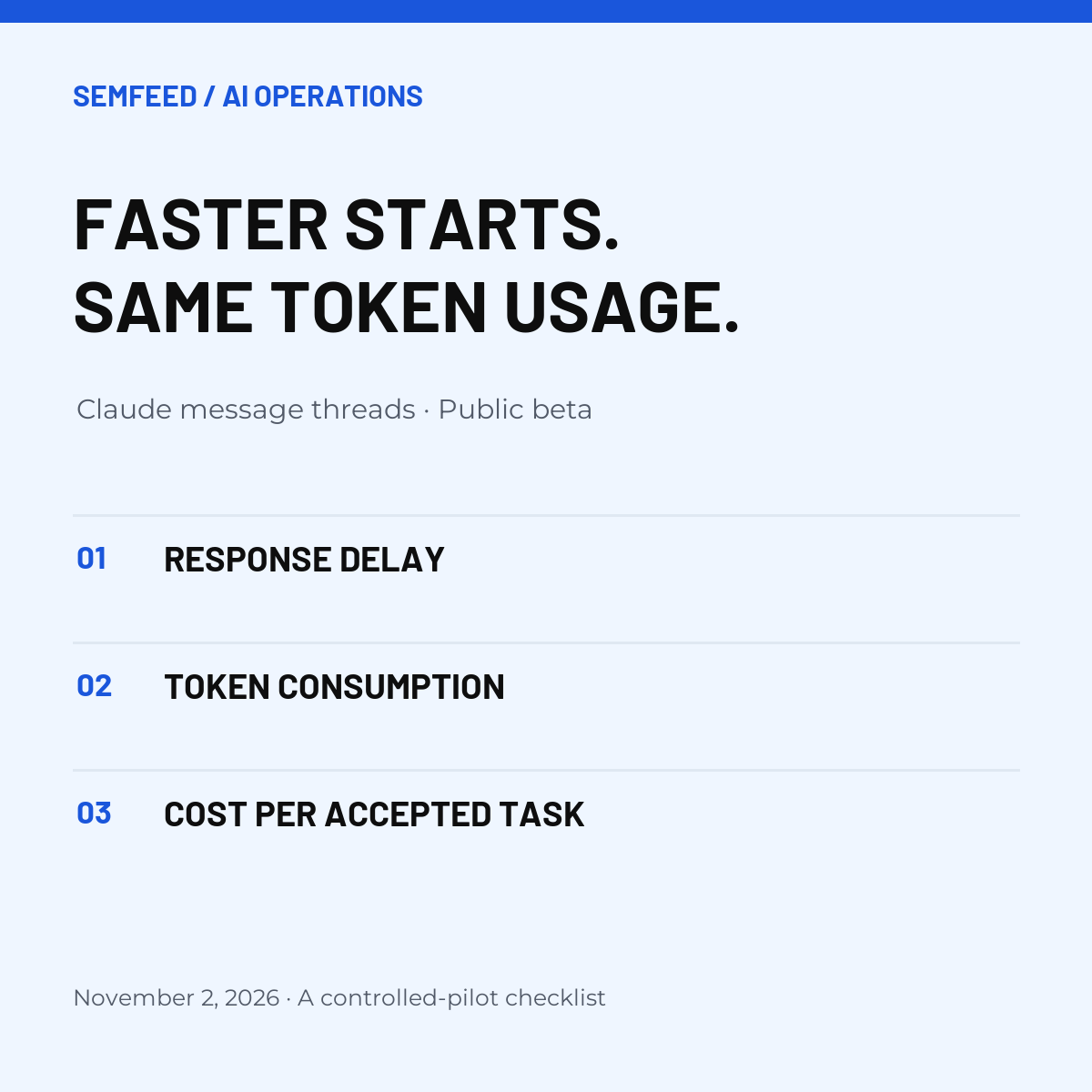
For an ecommerce team evaluating a long-running AI workflow, a quicker first response is useful. It still leaves a separate question: what does a completed, correct task actually cost?
Anthropic’s November 2 announcement introduces message threads in public beta. The change reduces repeated conversation uploads between active agent turns. It does not reduce the conversation the model processes or its token usage. Read the official announcement.
What message threads changes
The first request sends the conversation; subsequent requests send new messages and the previous response ID. Anthropic reports roughly 35% lower median time to first token for Claude Code requests containing 500,000–1,000,000 tokens. That is a vendor result for a particular workload, not a whole-task speedup or merchant outcome.
The beta spans Claude Platform and its listed AWS, Microsoft Foundry, and Anthropic-managed Google Cloud offerings. Standard token rates and existing rate limits apply. Threads expire after five minutes without a request, requiring history to be sent again. Thread data is encrypted in memory and not written to disk. Consult the technical documentation before implementation.
Choose a workflow where waiting matters
SemFeed’s editorial recommendation is to start with a bounded, read-only task. A developer could evaluate a draft catalog-quality report that checks a fixed sample of product descriptions against an approved checklist. This is a proposed pilot, not an announced Shopify integration or a customer case study.
Keep the task, model settings, input records, and expected output the same across comparisons. Include both an active sequence of turns and a pause long enough to test expiry. A narrow pilot is easier to investigate than a live workflow that edits products, contacts customers, and changes inventory at once.
Keep responsiveness and cost separate
A practical scorecard should answer four different questions:
- Responsiveness: How long until the first useful response, and how long until the full report is ready?
- Correctness: Does the result pass the same review checklist, with the same source evidence?
- Recovery: What happens after a pause, a failed request, or a replay? Does the client recover cleanly?
- Economics: What are token consumption, total API charges, and human correction time per accepted report?
Record these measures separately. A change in first-response delay cannot establish a change in end-to-end delivery time. A smaller request cannot establish a smaller token bill. Compare accepted outputs rather than counting every technically completed run as a success.
Decide using your own pilot
Before expanding the workflow, decide which result would justify the engineering effort. The team might prioritize a smoother interactive experience, fewer interrupted handoffs, or less time waiting for a report. Those are evaluation goals, not promised benefits.
Keep approval controls for consequential writes even if the agent feels more responsive. Our ecommerce computer-use safety checklist covers action classification, confirmation, and recovery evidence.
Sources and scope
This daily analysis uses Anthropic’s announcement and message threads documentation. The article displays November 2, 2026; its exact publication time and timezone were not disclosed, so assignment to this daily edition uses the displayed date rather than a verified Eastern timestamp.
By SemFeed Editorial Team · Daily AI operations analysis