
When an AI tool can click, type, and submit inside software, the operational question changes. The team no longer needs to review only what the model says; it needs to control what the model is allowed to do.
On November 1, Google Cloud marked its Computer use tool in Gemini Enterprise Agent Platform as generally available. The release also introduced configurable human-in-the-loop safety governance. For ecommerce teams evaluating interface automation, the governance model matters more than the novelty of automated clicking.
What Google Cloud released
Google Cloud’s dated release notes say the Computer use tool is generally available. Developers can configure or override confirmation policies for particular actions, including financial transactions and data modification. Administrators can enforce organization-wide guardrails through the configurableComputerUseToolSafetyPolicies constraint. Source: Google Cloud.
The release note does not establish a Shopify integration, universal account or regional eligibility, pricing, or merchant performance gains. Detailed product documentation linked from the release note returned a 404 during our verification, so teams should confirm current documentation and account availability before implementation.
Classify actions before automating a workflow
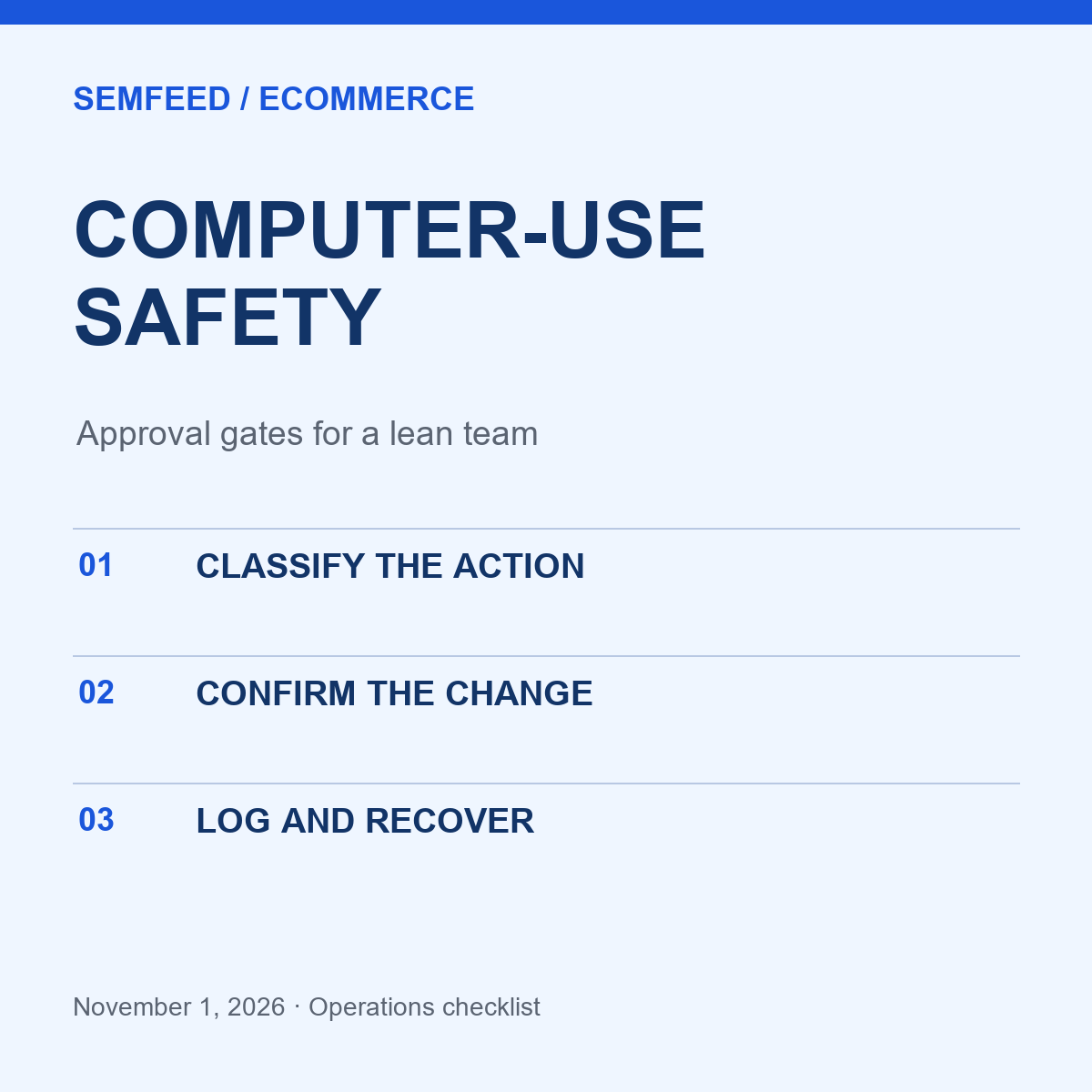
A lean ecommerce team should start with an action inventory. Label each step as read-only, reversible, consequential, or prohibited.
Read-only checks and draft generation are often better first tests than live changes. Examples include reviewing a test product record for missing fields, collecting information into a task list, or preparing a draft that a person must approve.
Publishing content, editing product details, changing inventory, sending customer messages, issuing refunds, and submitting payments are consequential writes. These actions need an explicit confirmation step that shows the reviewer the target, proposed change, and likely scope.
Make confirmation specific
A generic “Continue?” dialog is weak governance. A useful approval surface should answer:
- Which account, order, product, or customer record will change?
- What values will change from and to?
- Is the action reversible?
- Who is approving it?
- What evidence will remain after execution?
Financial transactions and data modifications are examples named in Google’s release note. Ecommerce teams should extend the same risk-based logic to their own operations rather than assuming one confirmation policy fits every task.
Preserve logs and a recovery path
Every test should record the request, the tool’s proposed action, the person who approved it, the execution result, and any correction. Use test accounts, sanitized data, or a tightly bounded task set before touching production systems.
If the team cannot explain how to stop, investigate, and reverse a failed run, the workflow is not ready for consequential automation. General availability describes product status; it is not a substitute for application-level controls and operational readiness.
A practical first test
Choose one low-risk process with a clear expected result. Define what the tool may observe, which actions it may propose, and which actions always require approval. Run representative cases, including incomplete data and an intentionally invalid request.
Measure completion accuracy, correction time, approval burden, and recovery effort. Do not evaluate the workflow only by whether the agent completed the happy path.
The useful lesson from this release is straightforward: as AI gains the ability to act, the team needs better boundaries—not fewer people in the loop.
Related reading: AI campaign controls for Shopify and Microsoft.