
A storefront team can want shoppers to discover its products through AI while making a separate decision about how its content is used for training. Before changing website rules, someone needs to write down which outcome the business actually wants.
An October 30 announcement from OpenAI makes that distinction timely. Two other updates that day—a fast-mode deprecation and a preview model release—also illustrate why ecommerce teams need different responses to different kinds of AI news.
What OpenAI announced
OpenAI plans to honor a shared robots.txt signal for foundational generative-AI training preferences. Implementation is intended in the coming months, and existing crawler controls remain in place. This is an announced change, not evidence that the new signal is already operational. Source: OpenAI.
For a lean ecommerce team, the immediate deliverable is an inventory of current rules, their purpose, and the person responsible for maintaining them. Avoid introducing an unverified directive because a headline suggests a new control exists.
Keep training preferences and discovery decisions separate
OpenAI’s current crawler documentation distinguishes GPTBot, associated with training, from OAI-SearchBot, associated with search. It describes their settings as independent. This is current documentation consulted for background, rather than a new October 30 feature announcement. Source: crawler documentation.
Start with a plain-language requirement: what should remain discoverable, and what training preference does the business want to express? Then ask the website owner to map that requirement to the applicable controls.
An audit should record the existing configuration before any edits. Include why each rule exists, who approved it, and how the team will check the intended behavior. Crawl access alone does not establish that a page will be recommended or generate sales.
Check whether an existing automation uses a retiring mode
Anthropic’s October 30 release note deprecates fast mode for Claude Opus 4.8, with removal scheduled for November 30. Requests to claude-opus-4-8 with speed: "fast" will then error. Anthropic identifies Opus 5.5 as the migration path for continued fast-mode use. The notice concerns that mode, not every Opus 4.8 request. Source: Anthropic.
This matters only if a workflow uses the affected configuration. An ecommerce operator should ask whoever maintains its automation to check the actual request settings. If a vendor manages the application, request confirmation of impact and its migration plan.
Before switching an affected workflow, run representative tasks through the replacement configuration. For product-copy work, check attribute accuracy and policy language. For reporting, check omitted information and unsupported conclusions. Record correction time alongside speed and usage cost.
Treat a preview model as an evaluation candidate
DiffuSpace’s October 30 publication introduces Clover-35B-A3B-Preview, with weights and code available. It is a preview diffusion language model using a mixture-of-experts architecture. Source: DiffuSpace.
For a team with development capacity, a bounded evaluation could test whether a model consistently identifies missing fields in sanitized product records. Define the expected answers before running the test. Review incorrect answers, retries, and maintenance effort rather than judging a polished demonstration alone.
A team without deployment capacity can simply track the release. A new model does not by itself justify a new infrastructure project, and its availability does not establish a ready-made integration with the store.
Assign one owner to each decision
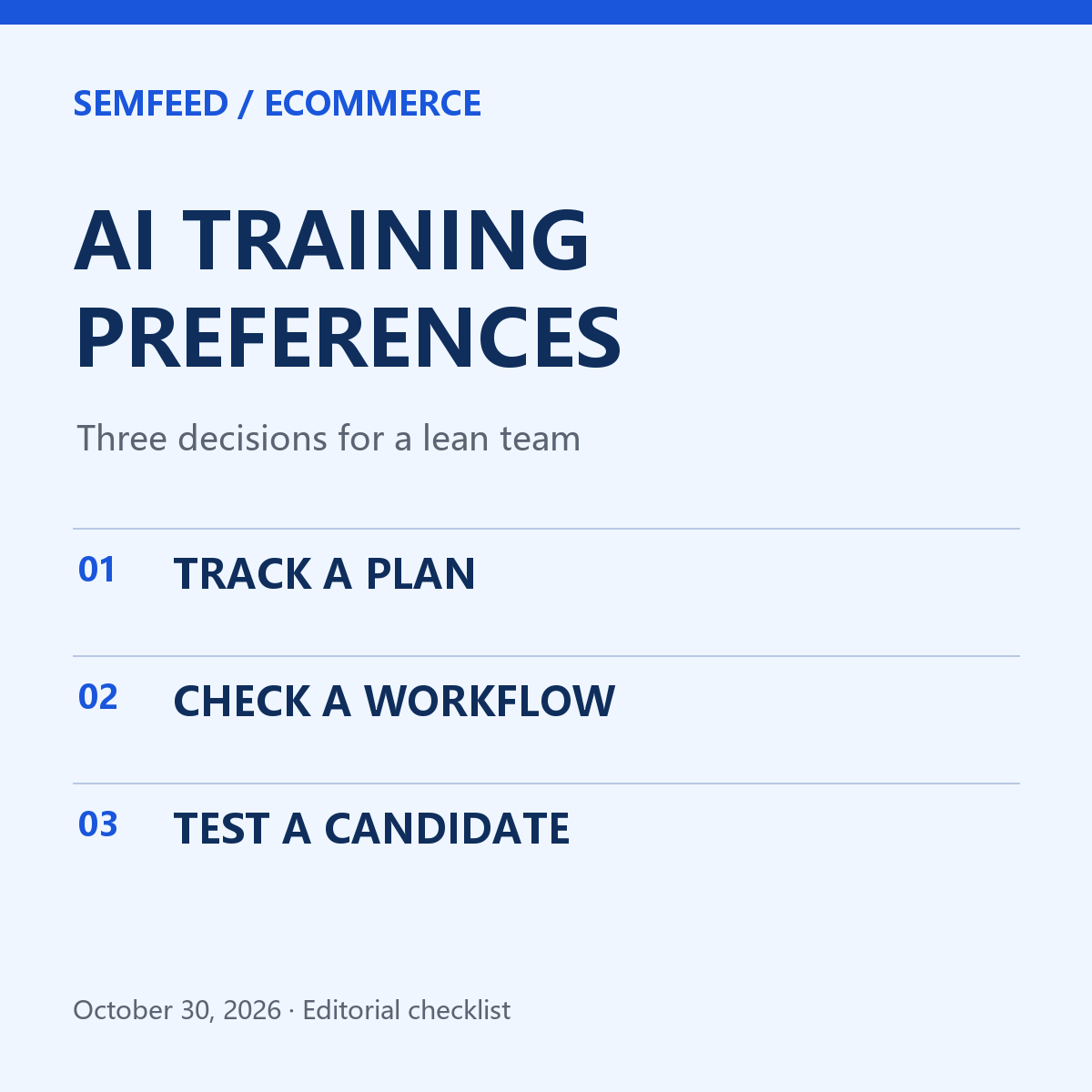
These updates call for three different responses: track implementation details, inspect affected configurations, and evaluate a candidate on a small task.
Put each relevant item into the team’s existing work tracker with an owner and next review date. That gives a small team a concrete way to respond to AI news without interrupting every operating process whenever a new announcement appears.
These recommendations are SemFeed editorial advice, not vendor-reported performance results. The selected announcements display October 30 dates; exact publication times and timezones were not available to establish precise membership in the Eastern observation window.