
SemFeed Editorial Team · Observation date: October 27, 2026 · America/New_York
Keeping translated product copy current and repeatedly adjusting product placement can consume a small ecommerce team’s attention. Two October 27 announcements address those workflows. The useful next step is to define what a controlled trial would need to prove.
This daily briefing covers Shopify’s regional translation update and Fast Simon’s product-discovery announcement. It separates official feature details from vendor statements and SemFeed’s operating advice. Neither announcement establishes a revenue or labor-saving result for your store.
Shopify translation sync: check region, cadence, and slots
Shopify’s official changelog, dated October 27, says Translate & Adapt can automatically translate new or changed content weekly for merchants in the United States and Canada, covering up to eight languages. This is a regional expansion, rather than the first global release. The page exposes a calendar date, with no exact publication time or timezone. Source: Shopify
Auto-sync is off by default and is enabled separately for each language. Manual translations remain protected. Auto-sync and Translate now share the eight language slots: using either method, or both, for a language consumes one slot. Weekly synchronization should not be read as immediate translation after every edit.
For an eligible team, a bounded check could start with one language and a small set of changed pages. Record when source copy changes, when translated content is checked, and which corrections a reviewer requests. That is an editorial testing suggestion, not an observed efficiency gain. Time-sensitive content still needs an explicit review plan.
What to confirm before enabling a language
Confirm merchant eligibility, identify the language slot being used, and assign someone to inspect the translated content. Decide how the team will handle content that cannot wait for a weekly cycle. Do not assume that a setting being enabled proves that all storefront copy is current or accurate.
Fast Simon AI merchandising: treat the announcement as a test candidate
Fast Simon announced Commerce-Native AI for product discovery for Shopify brands. According to the vendor, merchants set objectives and guardrails, and the system adapts product rankings and recommendations within those boundaries. The announcement includes controlled A/B testing. Source: Fast Simon
The original release is timestamped October 27, 2026, at 10:00 ET. The official host’s summary is dated October 28. This briefing uses the embedded original release timestamp as the event date; it does not treat the summary as a separate launch.
Fast Simon says the offering is immediately available. Pricing and account eligibility are unspecified in the announcement. These are vendor capability and availability statements. This briefing does not independently establish merchant ROI, savings, conversion gains, or revenue uplift.
Ask what the pilot will actually compare
Before adopting the tool, confirm access and pricing. If the team proceeds, define a limited product scope, the business rules that must hold, a named reviewer, and the existing approach to use as a comparison. Check which proposed controls are actually supported rather than assuming that every desired rule is available.
An A/B test compares alternatives under controlled conditions. Its usefulness depends on the team’s setup and evidence. A short-term revenue change by itself cannot tell you whether the model caused the change, especially when promotions or other store changes happen at the same time. This is SemFeed’s measurement advice, not a reported test result.
A practical checklist for a small DTC team
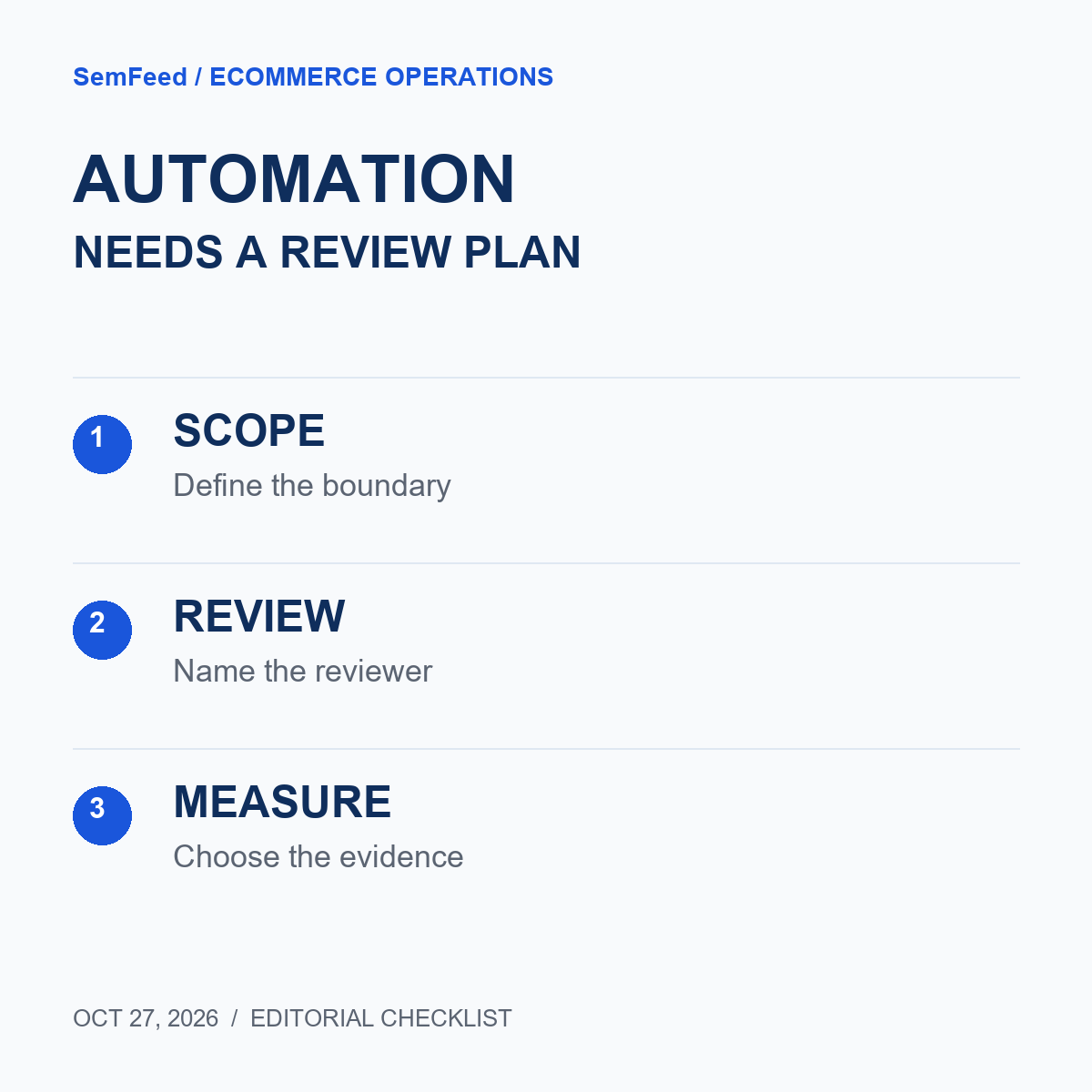
- Verify scope. Translation eligibility and weekly cadence differ from merchandising account access and vendor availability claims.
- Write the boundary. Specify which content or products belong in the trial and what must be escalated to a person.
- Name a reviewer. Decide who checks translation quality or unexpected merchandising behavior before expanding use.
- Choose evidence that fits the task. Translation needs freshness and accuracy checks. Merchandising needs a valid comparison and business-outcome review.
The two workflows can share a governance process without sharing one success metric. A translation trial may reveal content that needs correction. A merchandising trial may require more evidence before any conclusion about business impact. Both outcomes can be useful without supporting a promise of automatic growth.
What to do today
Choose one recurring task and write a short trial brief covering eligibility, scope, reviewer, evidence, and the decision to continue or stop. Keep the first commitment small enough to inspect. These are editorial recommendations for reducing uncertainty, not demonstrated outcomes from either announcement.
For a related view of human review and operational boundaries, read AI Long-Task Governance: What DTC Teams Should Verify. That article addresses broader AI workflow controls; it does not replace the product-specific checks above.
Sources and evidence limits
- Shopify: Translate & Adapt US/CAN update — October 27 calendar date; precise publication instant unavailable.
- Fast Simon: Commerce-Native AI announcement — October 27, 10:00 ET original release; October 28 host summary. Vendor statements, with unspecified pricing and account eligibility.
This briefing draws on two selected primary sources from the October 27 Eastern observation window. Coverage is not exhaustive. Recommendations are SemFeed editorial judgment; no merchant example, performance benchmark, or SemFeed product integration is asserted.
About the author: SemFeed Editorial Team prepares source-linked analysis for ecommerce operators, distinguishing platform announcements from operating recommendations.
Define your next controlled trial
Bring one workflow, its boundaries, and the evidence you need.