
Three October 26 updates show AI shopping moving beyond a recommendation interface: Shopify added merchant-controlled knowledge, Salesforce connected discovery with commerce operations, and Fanatics described a measured merchandising rollout.
Shopify gives merchants control over store facts for AI agents
Shopify’s new Knowledge base is available in the admin under Sales channels > Agentic > Knowledge base. Merchants can review, edit, and publish facts that AI agents receive about the store. Shopify drafts facts from published storefront pages and links each one to its source; drafted facts are not shared with AI agents until the merchant publishes them.
The page replaces the standalone Knowledge Base app, which Shopify says will be unavailable after January 15, 2027. Stores migrating from the app should check whether their facts moved and whether anything published during migration should be corrected or unpublished. This is a content-control feature, not evidence of ranking, traffic, or conversion lift.
What Salesforce announced for agentic commerce
Salesforce says its Universal Commerce Protocol integration is now live. Merchants can enable UCP-powered checkout on Google surfaces including Gemini and Google Search, including AI Mode, while remaining the merchant of record.
The release also includes natural-language catalog filtering, automated product categorization, multilingual Agentic Commerce Search, traffic-source reporting, and event-driven operations.
What is available to Shopify merchants?
Salesforce describes Agentic Commerce Search as an add-on for B2C Commerce and for merchants on other platforms, including Shopify, Adobe Commerce, and homegrown systems. Shopper Agent is described separately as an add-on for B2C Commerce customers.
That distinction matters. The announcement does not mean every Shopify account automatically receives Salesforce search, checkout, or shopper-agent features. It also does not provide universal pricing, implementation time, or conversion results.
What the Fanatics case adds
Fanatics launched an OpenAI-powered Shop the Look experience that uses enriched product data, team and inventory information, and merchandising rules to recommend coordinated in-stock products. OpenAI reports that the first 50-product test took less than 24 hours and that testing across roughly 30,000 MLB products produced 10% higher engagement than the prior experience.
Those figures are vendor-reported results from a large North American enterprise, not a benchmark for independent stores. The transferable lesson is the process: enrich data, apply inventory and merchandising constraints, review a bounded sample, and expand only after validation.
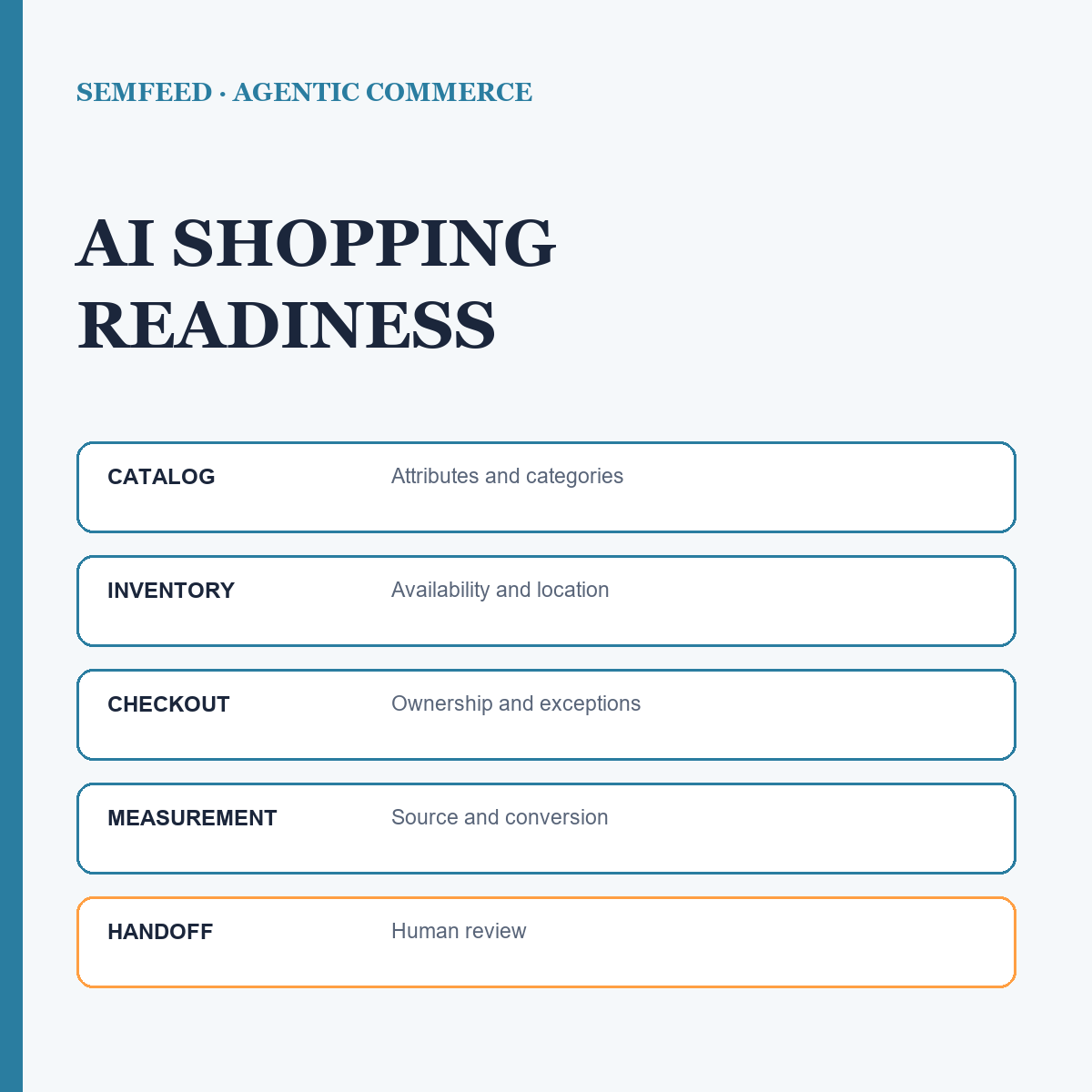
Five checks before an agentic commerce pilot
1. Product and store facts
Confirm that titles, attributes, categories, shipping details, and contact information are accurate, source-linked, and assigned to an owner.
2. Inventory freshness
Test whether availability stays accurate across the store, recommendation or search experience, and checkout path.
3. Checkout ownership
Document the merchant-of-record model and how payments, taxes, refunds, support, and order records move between systems.
4. Measurement
Define a consistent way to compare AI- or chatbot-originated engagement, revenue, orders, and conversion with search, social, and email.
5. Human exception handling
Set stop conditions for inaccurate facts, price conflicts, inventory mismatches, unusual orders, and payment exceptions.
A practical rollout for small DTC teams
Start with a bounded product set. Measure relevance, inventory accuracy, checkout completion, source attribution, engagement, and manual correction rate. These are SemFeed operating recommendations, not performance claims from Shopify, Salesforce, Fanatics, or OpenAI.
For a broader operating model, see SemFeed’s ecommerce analytics and AI operations articles.
Sources
Shopify: Knowledge base is now built into your admin (October 26, 2026).
Salesforce: Peak-Ready Precision — The October 2026 B2C Commerce Release (October 26, 2026).
OpenAI: How Fanatics and OpenAI streamline the fan experience (October 26, 2026).