
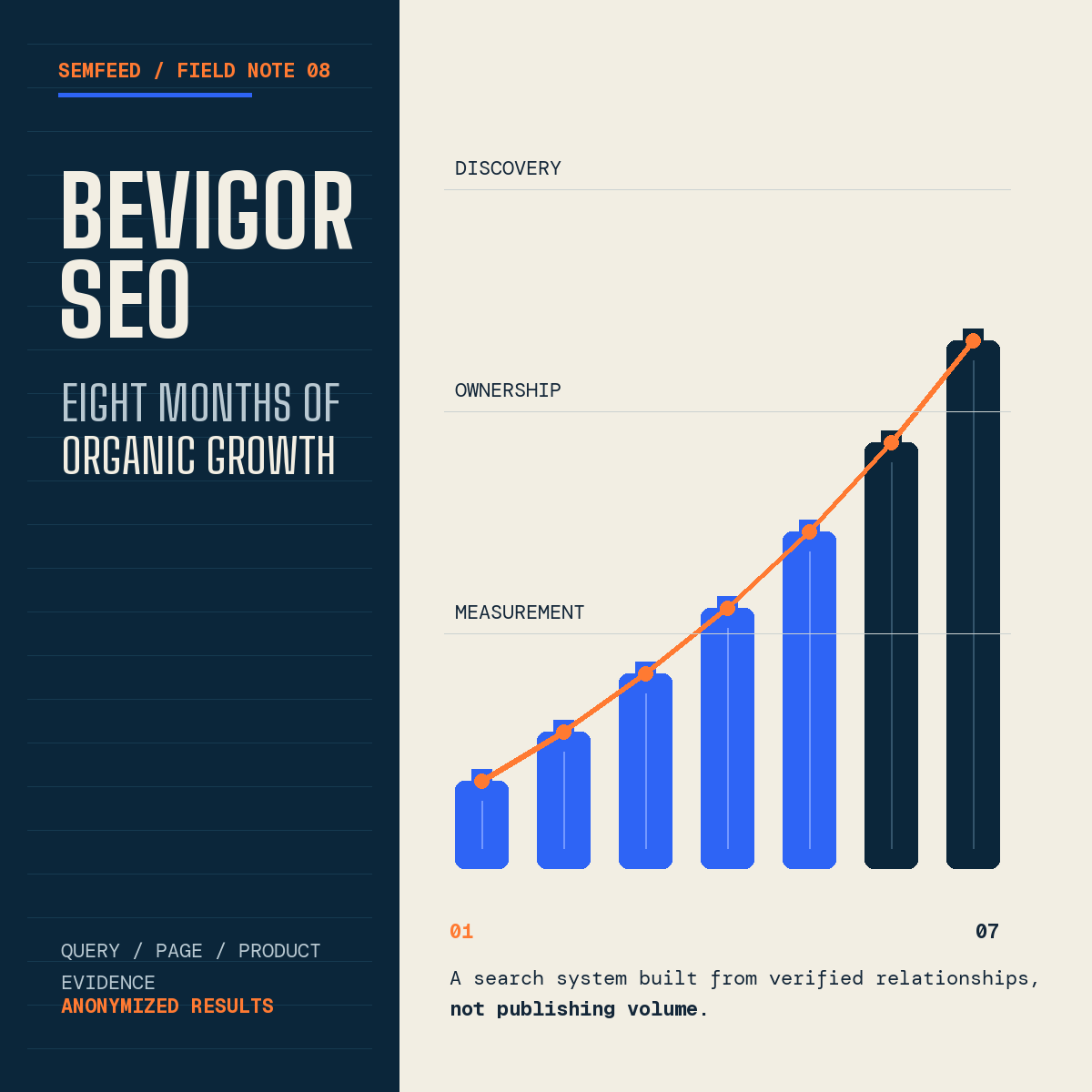
An established battery seller did not need more disconnected blog posts. It needed a system that connected real search demand to one primary page, a relevant product path, and measurement that did not overstate SEO’s contribution.
Case study period: February–September 2026 for Google Search Console; February–August 2026 for complete Shopify monthly data. The client is anonymized, and all performance figures are masked as ** from verified account exports reviewed for this case study.
Results at a glance
- Google organic clicks: ** → ** (growth: **)
- Google search impressions: ** → ** (growth: **)
- Storewide conversion rate: ** → **
- Orders: ** → ** (growth: **)
Storewide gains occurred during the SEO program, but they should not be attributed to SEO alone.
The ecommerce SEO challenge
The store sells AA, AAA, coin-cell, hearing-aid, and rechargeable batteries. That product range creates many legitimate search tasks, but it also makes content easy to fragment. A question about batteries for a Blink camera can be answered by several articles. A query about AA lithium batteries can be targeted by a blog post, a collection page, and a product page at the same time.
The team had to answer three operating questions:
- Which search problems were closest to real products and buying situations?
- Which single page should lead for each search intent?
- How should impressions, clicks, page behavior, and orders be measured without treating correlation as causation?
Those questions shaped the eight-month program.
Step 1: Establish a measurement contract
The project used three systems with different jobs:
- Google Search Console measured impressions, clicks, queries, and organic landing-page visibility.
- Semrush provided a third-party view of keyword coverage, estimated traffic, and authority signals.
- Shopify measured storewide sessions, conversion rate, orders, and net sales.
These datasets were not blended into one artificial number. Direct, Unknown, and Unattributed traffic in Shopify do not equal Google organic search. For that reason, the team did not describe broad non-paid revenue as SEO revenue or claim that SEO alone caused the order increase.
The measurement sequence was more defensible: determine whether search coverage expanded, confirm whether clicks followed, identify whether more pages became stable entrances, and then observe whether store conversion and orders improved during the same period.
Step 2: Turn scattered content into owned search topics
Prioritize observed queries
Content priorities were based on queries already appearing in Search Console, their average positions, page type, and the store’s ability to serve the underlying product need. A relevant query already ranking in positions 11–20 can be a better opportunity than a new high-volume term with no visibility or product fit.
Queries such as “best batteries for blink camera” and “cr123 vs cr123a” were reviewed for title clarity, answer completeness, snippet appeal, and page ownership before the team considered writing another similar article.
Assign one primary page to each search task
The team built a Query × URL ownership map. One page was assigned to the primary question; supporting pages handled narrower scenarios and linked back to the owner. Where several pages answered the same need, the strongest existing page became the primary candidate instead of adding another competing URL.
This does not mean every repeated query is cannibalization. Multiple pages can legitimately appear for different tasks. The map created a review process: compare intent, page role, and performance before deciding whether to update, consolidate, or keep both.
Refresh existing content and fill verified gaps
Pages entered the refresh queue when rankings declined, impressions were high but clicks were weak, or product information had become outdated. Updates addressed answer order, intent match, product support, FAQs, titles, descriptions, and internal links—not surface-level wording changes.
New articles were created only for confirmed gaps. This allowed blog posts, collections, and product pages to develop distinct roles.
Connect educational traffic to product decisions
Battery searches are often practical: which battery fits a camera, whether two coin-cell models are compatible, or whether a remote needs AA or AAA batteries. Useful content therefore had to explain specifications, compatibility, limitations, and the next step—not simply attract a visit.
What changed after eight months?
Google organic clicks and impressions
| Google Search Console metric | February 2026 | September 2026 | Change |
|---|---|---|---|
| Organic clicks | ** | ** | ** |
| Search impressions | ** | ** | ** |
Impressions grew faster than clicks. That is evidence of wider query coverage, but it also identifies the next constraint: titles, descriptions, answer quality, and intent alignment still need to convert that visibility into qualified visits.
From October 1–18, Search Console recorded additional clicks and impressions, shown as ** because the period and client results are anonymized. Because October was incomplete, those figures were treated as directional evidence rather than compared with a full month.
Non-branded discovery expanded
Among queries returned by Search Console, non-branded impressions increased from ** in February to ** in September. The growth rate is masked as **. More users were discovering the store through battery use, compatibility, and selection questions rather than beginning with the brand name.
Search Console suppresses some low-volume queries for privacy. Query-level totals therefore do not reconcile perfectly with site totals and should not be treated as a complete branded-versus-non-branded share.
Content became a repeatable entry point
By August 31, several articles had measurable organic entry performance:
- AA lithium vs. Energizer comparison: ** clicks and ** impressions
- Remote-control battery guide: ** clicks and ** impressions
- “What uses AAA batteries”: ** clicks and ** impressions
- Blink camera alkaline-battery guide: ** clicks and ** impressions
The high-impression, low-click pages were not declared failures. They became a prioritized optimization queue.
What happened to storewide performance?
Complete Shopify monthly data was available through August 2026.
| Shopify metric | February 2026 | August 2026 | Change |
|---|---|---|---|
| Storewide sessions | ** | ** | ** |
| Storewide conversion rate | ** | ** | ** |
| Orders | ** | ** | ** |
| Net sales | ** | ** | ** |
These masked results show that store conversion efficiency and commercial outcomes improved while organic search visibility expanded. They do not prove that SEO caused the full sales increase. Pricing, merchandising, promotions, repeat purchases, direct traffic, and other channels may also have contributed.
The defensible conclusion is narrower: SEO created more search entry points, and the store converted more of its total sessions during the same period. Quantifying SEO’s independent contribution requires natural-landing-page, add-to-cart, order, and revenue attribution over comparable periods.
The operating system behind the result
The most reusable part of this ecommerce SEO case study is not one percentage. It is the operating model:
- Query to page: assign an owner page to each important search task.
- Page to product: answer the problem and help the shopper confirm specifications, compatibility, and next steps.
- Impression to click: improve high-visibility pages rather than measuring success by publishing volume.
- Traffic to business outcome: keep Search Console, Semrush, and Shopify metrics in their proper scopes.
This turns SEO from a publishing calendar into an evidence-based operating system. Teams can explain why a page should change, which page owns the task, and how the result will be evaluated.
Next priorities
- Optimize purchase-relevant queries already ranking in the top 20.
- Run title and description tests on high-impression, low-click pages.
- Clarify owner pages for Blink, AA lithium, and trail-camera topics.
- Compare the 28 days before and after each content refresh.
- Build a stricter view from organic landing page to add-to-cart, order, and revenue.
What DTC teams should take away
More content was not the strategy. The strategy was to route the right search problem to the right page, connect that page to a useful product decision, and preserve the evidence needed to evaluate the change.
Explore SemFeed’s DTC ecommerce SEO services, review more client case studies, or request a strategy assessment.