
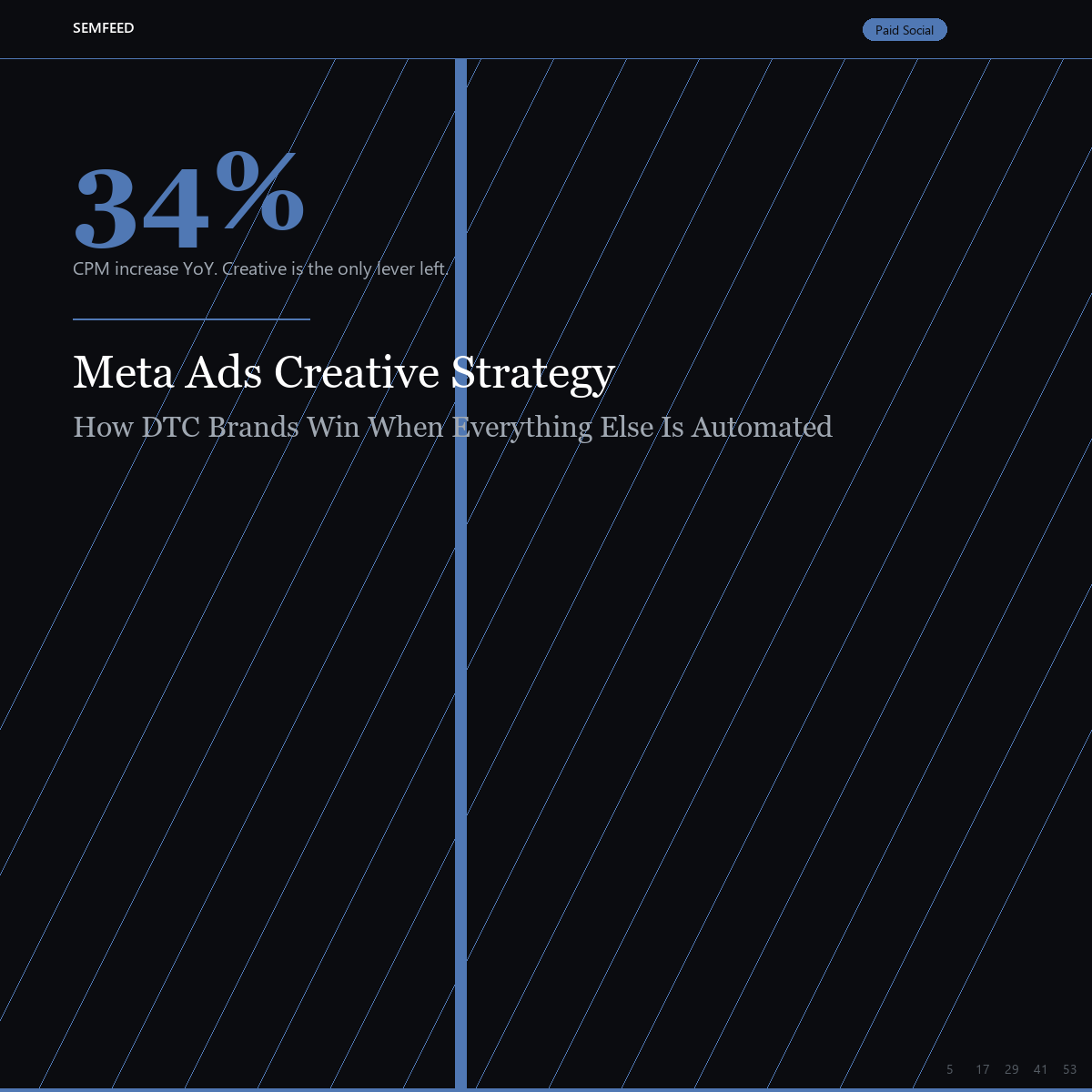
Let’s cut to the numbers: Meta Advantage+ Shopping CPMs rose ~34% year-over-year. Median blended ROAS across Meta dropped from 3.8× (Q1 2026) to 3.1× (July 2026) for brands spending $50K–$500K/month. And in May 2026, Meta removed manual audience caps for accounts spending $10K+/month — the last bit of audience control gone.
Audience targeting is fully automated. Budget allocation is increasingly algorithmic. Creative is the only real lever you have left.
Here’s what the top-quartile DTC brands (still hitting 4.4×+ blended ROAS) are doing differently.
The Meta Ads Reality Check (Q2 2026 Benchmarks)
| Vertical | Blended ROAS | CTR Range | Typical CPM | Prospecting ROAS |
|---|---|---|---|---|
| Fashion / Apparel | ~3.8× | 1.8–2.8% | $16–$28 | 1.8–3.2× |
| Home Goods / Furniture | ~3.2× | 1.0–1.9% | $12–$24 | 2.0–4.0× |
| Beauty / Skincare | ~4.4× | 1.6–2.5% | $18–$32 | 2.5–4.5× |
But here’s the important number: the gap between median and top-quartile brands is almost entirely explained by creative velocity and testing rigor. The top 25% of brands produce 15–25 new ad concepts per month. The bottom 50% produce fewer than 5 and wonder why their ROAS keeps sliding.
Related: SemFeed Paid Social Services — creative-led Meta, TikTok & Pinterest ads for DTC brands
The Creative Velocity Mandate
Creative fatigue — when frequency exceeds 2.5 and CTR starts dropping — is the #1 silent ROAS killer in Meta Ads. The antidote is simple but hard to execute: produce more creative, faster, and kill what doesn’t work sooner.
How Many Ads Do You Really Need?
| Monthly Ad Spend | New Concepts/Month | Refresh Cadence | Active Ads at Any Time |
|---|---|---|---|
| $5K–$15K | 8–12 | Every 14 days | 15–25 |
| $15K–$50K | 12–20 | Every 10 days | 25–40 |
| $50K–$200K | 20–30 | Every 7 days | 40–60 |
| $200K+ | 30–50 | Every 5–7 days | 60–100+ |
But counter-intuitively: more isn’t always better. Triple Whale data shows accounts with fewer than 20 active creatives had 18% higher median ROAS than accounts with 40+. The key is that those 20 are well-funded, structured, and hypothesis-driven — not a random spray of variations. Northbeam found consolidated accounts reach stable CPA in 10–12 days vs. 21–28 days for fragmented accounts.
The synthesis: high volume of structured, well-funded concepts, with strict kill criteria. Not 60 random variants.
When to Kill an Ad
Top DTC operators kill underperformers at ~$150 in spend rather than waiting for Meta’s algorithm to “optimize.” Kill criteria:
- CTR below 1% after $100–150 spend (for cold audiences)
- CPM more than 2× your account average
- Zero add-to-carts after 1,000 impressions
- Frequency above 2.5 with declining CTR
The Creative Format System That Separates 8× from 1.8×
Analysis of 400+ live fashion/home/lifestyle ads in Q2 2026 reveals a clear pattern: the brands hitting 4–8× ROAS use a deliberate 4–5 format system, not random creative production.
| Format | Purpose | Best For | Typical ROAS |
|---|---|---|---|
| Raw UGC Video (15–30s, 9:16) | Cold audience prospecting | First touch, brand awareness | 1.5–2.5× |
| Lifestyle Carousel (3–5 cards) | Warm retargeting, product consideration | Site visitors, video viewers (50%+) | 2.5–4.0× |
| Education / How-To Video (30–60s) | Mid-funnel, category education | Engaged audiences, new category entrants | 2.0–3.5× |
| Enriched DPA (lifestyle model shots + product) | High-intent close | Cart abandoners, PDP viewers | 4.0–8.1× |
| Static + Bold Headline | Volume filler, ASC breadth | Feed placements, broad audiences | 1.0–2.0× |
The magic is in the sequence: UGC hooks cold traffic → Lifestyle carousel builds consideration → Enriched DPA closes the sale. Brands that sequence UGC into enriched DPA retargeting see 55–65% higher iROAS than brands running each format independently. Generic static catalog retargeting averages 1.8× ROAS. Enriched DPA (real model shots with outfit or lifestyle context) peaks at 4.0–8.1× — a 73–115% ROAS lift from adding lifestyle context.
UGC Over Studio. Every Time.
Smartphone-shot, creator-style UGC outperforms polished studio creative 2.1× in cold-audience prospecting. One apparel brand reallocated 60% of its creative budget to UGC sourcing and saw CPMs drop 18% in six weeks. Top-performing US fashion ads are now 70–80% UGC.
What a winning UGC ad looks like:
- 1.5-second hook: problem-focused, not product-focused (“Why does my moisturizer make my face feel tight?” beats “Introducing our new moisturizer”)
- 15–30 seconds, vertical (9:16 for Reels)
- Burned-in captions (85% of Reels are watched without sound)
- Real person, real room, real reaction — not a ring light and script
- One clear CTA: “Tap to shop” or “Link in bio”
Advantage+ Shopping Campaign Structure
ASC budget allocation among DTC brands rose from 22% (Q1 2025) to 54% (Q2 2026). ASC averages 3.1× ROAS vs. 2.4× on legacy manual campaigns. But the May 2026 update removed manual audience caps — brands that migrated >60% of budget to ASC without adjusting their creative infrastructure saw ~18% average CAC increases.
The Two ASC Models That Work
Model A — Two-Campaign (Recommended for most DTC brands):
- ASC (60–70%): Full-funnel acquisition + retargeting combined. 8–15 proven creative assets. Existing-customer budget cap at 10–20%.
- Manual CBO Prospecting (20–25%): For testing new creative angles before feeding winners into ASC. Broad targeting, 3–6 new concepts per week.
- Optional Manual Retargeting CBO (10–15%): Cart abandoners + PDP viewers. Many brands running mature ASC drop this entirely.
Model B — Three-Layer (Higher spend or longer purchase cycles):
- ASC Prospecting (60–70%): 1–2 ASC campaigns, fed by pixel + CAPI + first-party data
- Warm Retargeting (15–20%): Manual campaign targeting site visitors, video viewers (50%+ completion), Instagram engagers. Use DPA.
- Customer Winback (10–15%): Lapsed purchasers (90–180 days), new launches or loyalty offers
ASC minimums: ~50 purchase events per week for algorithm stability. $150–$300/day minimum spend per ASC campaign. Scale by no more than 20% every 5–7 days. Plan for 60–90 days before judging results.
Measurement: Why Your ROAS Numbers Are Wrong
Meta’s native reporting inflates ROAS by 30–60%. If you’re making budget decisions based on Ads Manager alone, you’re flying blind. One agency’s incrementality test found only ~22% of Meta’s claimed conversions were truly incremental for a beauty client.
The Minimum Measurement Stack
| Layer | Tool / Method | Purpose |
|---|---|---|
| 1 | Meta Ads Manager (7-day click, 1-day view) | Relative creative comparison only — not truth |
| 2 | Server-side CAPI + Enhanced Conversions | Improve match rates; pixel alone drops 35–45% of conversions |
| 3 | Multi-touch attribution tool (Triple Whale, Northbeam, Rockerbox) | Cross-channel attribution with a consistent model |
| 4 | Quarterly incrementality tests (Meta Conversion Lift, geo holdouts) | Measure true incremental contribution |
| 5 | MER (Marketing Efficiency Ratio) | Total revenue ÷ total ad spend — the one number that can’t lie |
CAPI is non-negotiable in 2026. Pixel match rates have degraded to 55–65% for most Shopify stores. Target an Event Match Quality (EMQ) score of 7.5+. Scores below 6.0 materially degrade prospecting. Brands with strong CAPI see 15–22% more attributed conversions.
Track MER weekly. Healthy DTC brands target a MER of 3.5–5.0× (total revenue ÷ total ad spend). If your blended ROAS looks great but MER is slipping below 3.0, Meta is claiming credit for conversions that would have happened anyway.
Related: SemFeed Paid Social — creative-led, ROAS-driven Meta advertising
The Creative Concept Matrix: How to Test Systematically
Random creative testing is the fastest way to burn budget. Top operators test simultaneously across three dimensions:
| Variable | Variations to Test | Example |
|---|---|---|
| Hook Type | Problem-agitate, social proof, demonstration, curiosity gap | “I tried 12 moisturizers. Only 1 didn’t break me out.” |
| Format | UGC video, founder video, static, carousel, enriched DPA | Same hook, tested as Reel vs. carousel vs. static |
| Offer Angle | Discount, free shipping, guarantee, bundle, scarcity | “20% off first order” vs. “Free returns for 60 days” |
Win criteria: one hook type significantly outperforms others → double down on that hook with format and offer variations → feed winning combinations into ASC → repeat.
Ready to Rebuild Your Meta Creative Engine?
SemFeed’s Paid Social team handles everything from creative production (in-house UGC, video, carousel, static) to campaign structure, CAPI setup, and weekly reporting. We optimize for ROAS + retention — the two numbers that actually matter — with transparent, risk-shared pricing.
Talk to us about your Meta Ads strategy →