
DTC SEO in 2026: AI Search Is Eating Your Organic Traffic
Published: August 3, 2026 | Read time: 8 min | Category: SEO
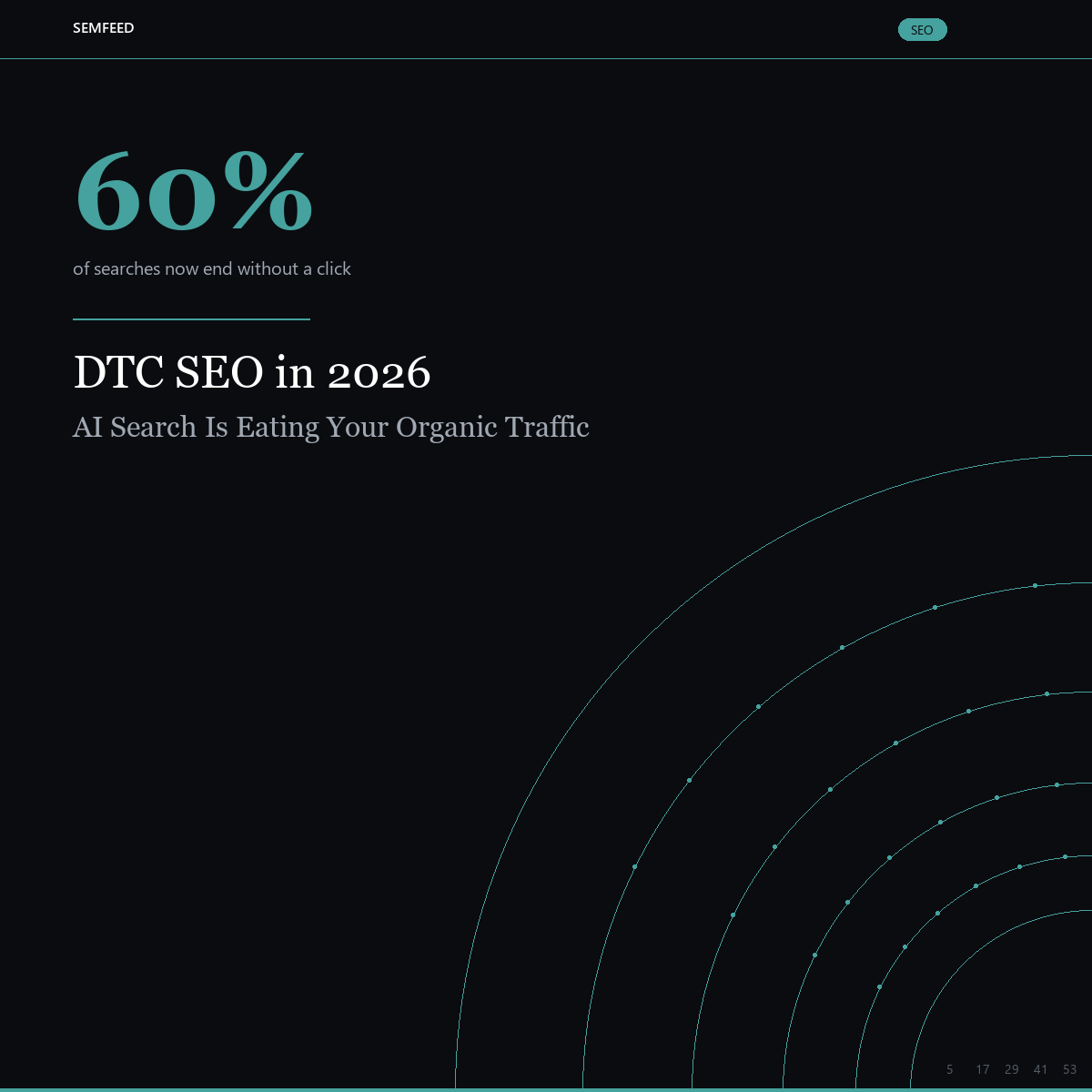
If your DTC SEO strategy still revolves around tracking 10 blue links on a Google SERP, you’re optimizing for a world that’s already gone. As of mid-2026, roughly 60% of searches end without a click. Google AI Overviews appear in ~48% of US searches. ChatGPT handles over 2 billion queries a day. Pages cited in Google AI Overviews earn roughly 120% more organic clicks per impression than non-cited pages on the same SERP.
SEO in 2026 means being the answer an AI picks. Not just the link someone might click. This article breaks down what that actually requires.
What Changed: The Zero-Click Takeover
Three numbers frame the shift for DTC brands:
- 67% — share of product research that still starts on Google (down from 89% in 2023)
- 38% — average organic click loss when an AI Overview appears on the SERP
- ~16% — year-over-year decline in Google organic traffic to brand sites
Comparison queries are the most affected: “Brand A vs Brand B” searches trigger AI Overviews 95.4% of the time. If you don’t have a comparison page, your competitor’s page gets cited — and the customer never reaches your site.
But there’s good news: AI-referred visitors are pre-qualified. They arrive with context, convert at higher rates, and cost less to acquire over time. AI-attributed orders on Shopify alone grew nearly 13× year-over-year between 2025 and 2026. The opportunity is real — it just requires a different playbook.
Related: SemFeed SEO Services — KPI-backed rankings verified by SEMrush
The New Metric: AI Mention Share
Traditional SEO tracks rankings and organic traffic. The 2026 DTC brand also tracks AI mention share: how often your brand, products, or content appears in answers from ChatGPT, Perplexity, Gemini, Claude, Google AI Overviews, and Microsoft Copilot.
Each platform weights signals differently, which means one optimization can’t cover all:
| Platform | What It Values Most | Best Optimization Approach |
|---|---|---|
| Google AI Overviews | Google index, schema, topical depth | Strong traditional SEO + FAQ schema + answer-first content |
| ChatGPT | Broad authority, comparison content, community presence | Editorial coverage + Reddit/Quora activity + comparison pages |
| Perplexity | Direct answers, structured data, embedded images | Question-restated headlines + single-sentence answers + media |
| Claude | Authoritative editorial sources, original research | Data-backed content + expert bylines + research reports |
| Gemini | Google data + Google Business Profile | Complete GBP + consistent entity data across the web |
Pro tip: Start with Perplexity. It cites sources transparently at the top of every answer, giving you the fastest feedback loop. Search your target queries, see which competitors get cited, and reverse-engineer what they’re doing right.
Structured Data: The Non-Negotiable Foundation
Most Shopify themes ship with basic Product microdata — name, image, price. That’s table stakes in 2023. In 2026, pages with complete schema are 2.5× more likely to be cited in Google AI Overviews, and rich results with ratings and pricing achieve up to 82% higher CTR than plain links.
Here’s the minimum schema stack every DTC site needs in 2026:
| Schema Type | Where | What It Unlocks |
|---|---|---|
| Product | Product pages | Rich results with price, availability, reviews in SERP |
| Organization | Homepage | Knowledge Graph panel, brand entity in Google |
| BreadcrumbList | Sitewide | Breadcrumb rich results, clearer site hierarchy for crawlers |
| FAQ | Product, collection, blog pages | FAQ rich results + AI answer engine citation |
| Review | Product pages | Star ratings in SERP (20-40% CTR uplift) |
| Article | Blog posts | Article rich results, AI citation for informational queries |
One critical warning: Duplicate schema is the most common error we see in DTC site builds. If your theme outputs Product schema AND your SEO app outputs Product schema, you’ve got conflicting data. Merge everything into a single nested JSON-LD @graph block. Test every page with Google’s Rich Results Test tool.
Content That AI Actually Cites
AI models don’t care about “luxurious, hand-crafted, expertly formulated.” They care about specific, verifiable, factual information. Here’s what gets cited versus what gets ignored:
| Gets Cited ✅ | Gets Ignored ❌ |
|---|---|
| Ingredients with percentages, specs with dimensions, verifiable claims | “Premium quality,” “luxurious feel,” “expertly crafted” |
| Comparison pages: “Brand A vs Brand B,” “Is [brand] worth it?” | Generic product descriptions copied from the manufacturer |
| Answer-first content: question in H2, direct answer in first sentence | Marketing fluff paragraphs before getting to the point |
| Original data: surveys, test results, benchmark reports | Regurgitated industry statistics without attribution |
| FAQ sections with concise, factual answers | Vague Q&A that reads like a sales pitch |
Content formats that win in 2026:
- “Best for X” collection pages — e.g., “sensitive skin picks,” “under $50,” “best for travel” — with buyer context, selection criteria, and FAQs
- Comparison pages — “Brand vs Competitor,” “Is [brand] worth it?,” “best alternatives to [competitor]”
- Ingredient or material knowledge bases — dictionaries, sourcing standards, safety FAQs
- Product-linked buying guides — “how to choose a moisturizer for oily vs. dry skin”
Shopify Technical SEO: The 2026 Checklist
Before you write a single word of content, get the technical foundation right. Here’s the 4-phase audit sequence we use for DTC brands:
Phase 1: Crawlability (Weeks 1–3)
- Fix duplicate product URLs — Shopify generates
/products/handleand/collections/.../products/handle. Both can get indexed. Remove thewithin: collectionfilter from your Liquid product card templates. - Block faceted navigation — filter URLs (
?filter.p.*=...) create thousands of thin pages. Block them inrobots.txt. - Audit 404s and redirects — use Google Search Console’s Pages report + Screaming Frog. Every broken internal link costs crawl budget.
- Don’t block AI crawlers — ensure GPTBot, PerplexityBot, ClaudeBot, and Google-Extended are allowed in
robots.txt.
Phase 2: Performance (Weeks 3–5)
- Core Web Vitals — Google reportedly tightened LCP threshold from 2.5s to 2.0s in March 2026. Kill app bloat, serve WebP/AVIF images, preload hero images with
fetchpriority="high". - Mobile-first — Google uses mobile page experience as its primary ranking signal. If your mobile menu breaks on a Galaxy S24, fix it before touching keywords.
Phase 3: Structured Data (Weeks 5–7)
Implement the full schema stack described above. Validate with Google Rich Results Test + Schema.org Validator. Invalid schema is worse than no schema — it triggers “ambiguous data” errors in GSC.
Phase 4: Content & Internal Linking (Weeks 7–12)
- Collection pages — the most underused SEO asset in DTC. Add 150–300 words of unique, keyword-targeted content above the product grid.
- Internal linking — every product page should link to its parent collection. Every blog post should link to relevant product or collection pages.
Need a technical audit for your Shopify store? SemFeed’s SEO team covers technical audits, keyword strategy, content, and link building — with KPIs written into the contract and verified by SEMrush.
The Timeline: How Long Does AI Visibility Take?
AI visibility is a compounding asset, not a quick win. Here’s a realistic timeline for a mid-size DTC brand starting from scratch:
| Phase | Timeframe | Expected Outcome |
|---|---|---|
| Technical foundation | Weeks 1–6 | Site passes Core Web Vitals, schema validated, no crawl errors |
| First AI citations | 3–6 weeks | Sporadic mentions in Perplexity and AI Overviews for niche queries |
| Meaningful mention share | 3–6 months | Consistent citation across 2–3 AI platforms for target queries |
| Measurable traffic/revenue impact | 9–12 months | Organic + AI-referred revenue contribution visible in analytics |
The competitive window is estimated at 12–18 months before category defaults are set. Brands that start building AI visibility now will have a moat competitors need a year or more to catch up to. The ones waiting for a “best practice guide” to emerge will find the door already closed.
Ready to Build Your AI Visibility?
At SemFeed, we combine traditional SEO fundamentals with the AI search optimization playbook — technical audits, structured data implementation, content strategy, and ongoing SEMrush-verified KPI tracking. Our SEO contracts come with a guarantee: if we don’t hit 70% of agreed KPIs, we extend service for free up to 3 months, and if we’re still short, we refund 20%.