SemFeed Editorial Team · Observation date: October 29, 2026 · America/New_York
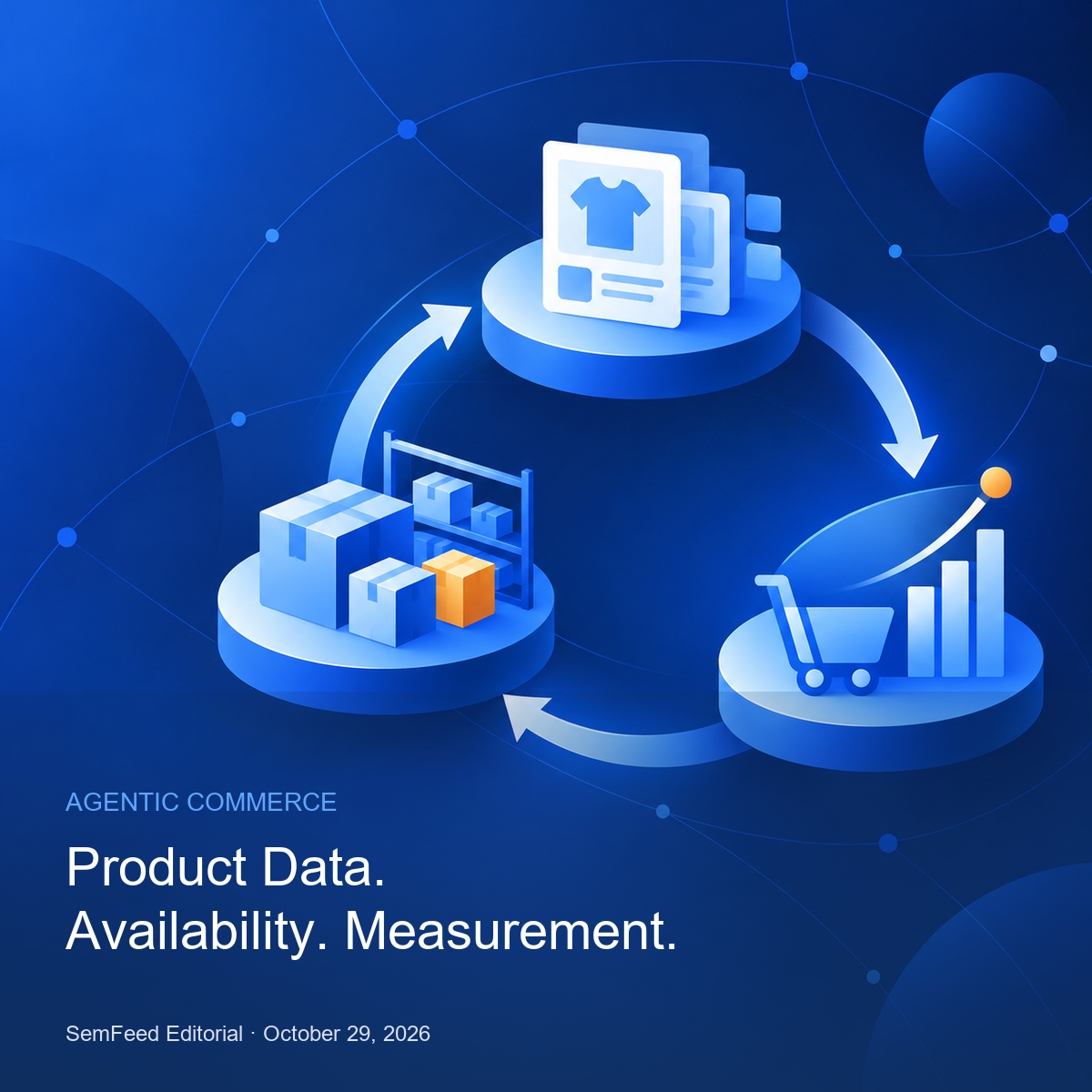
AI shopping is moving from product answers toward recommendations and purchases. That shift makes the interface less important than the data behind it. An agent can only make a useful recommendation if it understands the product, sees current availability, and leaves a measurable path from discovery to sale.
An October 29 announcement from NielsenIQ and Google puts those three layers—product intelligence, availability, and measurement—into one operating picture. For DTC teams, the immediate opportunity is not a new universal merchant feature. It is a clearer checklist for making a limited product set ready for AI-mediated discovery.
What NIQ and Google announced
NIQ and Google announced a broad collaboration on agentic commerce. The companies say they intend to bring NIQ retail and product intelligence together with Google’s AI commerce ecosystem to improve product discovery and local availability.
The announcement says the parties are looking to complement Google’s Shopping Graph—described as containing more than 60 billion product listings—with NIQ Commerce Intelligence. NIQ describes relevant inputs including Product Intelligence for more than 250 million products and Store Intelligence supported by retail-location and sales tracking across 90 countries.
The three layers behind AI shopping
1. Product facts that machines can interpret
AI discovery depends on more than a product title and a few keywords. Attributes, variants, materials, dimensions, compatibility, usage context, policies, and media need to be complete and internally consistent.
NIQ’s earlier Connected Content announcement describes standardizing attributes, resolving product identity across systems, and enriching product data so AI systems can match and recommend products. NIQ says that solution is available in the United States. That is a product-availability statement from NIQ, not a guarantee that every retailer needs the product or will receive better results.
For a DTC team, the transferable practice is to audit a bounded set of priority products. Check whether a shopper—or an agent—could answer who the item is for, when it is appropriate, which variant fits, and what constraints apply without reconciling conflicting pages.
2. Availability that stays current
A relevant recommendation still fails if an item is out of stock, cannot ship to the shopper’s market, or reaches checkout with a different price. The October 29 announcement emphasizes local availability because agentic commerce needs a reliable answer to both “what fits?” and “can I buy it now?”
Small teams should compare product feeds, storefront pages, regional settings, inventory records, and checkout behavior. Exceptions need owners and stop conditions. This is an operating recommendation, not a claim that the NIQ-Google collaboration currently resolves those issues for Shopify merchants.
3. Measurement from recommendation to purchase
NIQ is integrating Google’s open-source Meridian marketing mix modeling framework into NIQ Cadence. NIQ’s September 30 announcement says Meridian is available within Cadence and connects data, modeling, scenario planning, optimization, and ongoing monitoring.
The October 29 release also describes using real-world purchase data and location-based experiments with Meridian GeoX. That points toward a broader goal: connecting what an AI system recommends with what a shopper buys and what actually drives growth.
For an independent store, the first step is usually more basic. Preserve referral information where possible, use consistent campaign and landing-page conventions, separate known from unknown traffic, and record a baseline before changing product data or discovery experiences. Do not describe unattributed traffic as AI-driven revenue without evidence.
What is live, and what remains planned?
The October 29 announcement combines existing components with future collaboration goals:
- Meridian is already described by NIQ as available inside NIQ Cadence.
- NIQ Connected Content/Product Intelligence is described as available in the United States.
- The broader work to combine NIQ intelligence with Google’s AI commerce ecosystem is an announced collaboration. The release says specific initiatives and milestones will be shared later.
A four-part readiness audit for lean DTC teams
Start with 20 priority products rather than the entire catalog. This is an editorial suggestion to bound the workload, not a platform requirement or a validated performance threshold.
- Product facts: verify titles, attributes, variants, dimensions, materials, compatibility, policies, and usage context.
- Availability: compare inventory, price, shipping region, and checkout status across the feed and storefront.
- Source visibility: document how analytics distinguishes AI, search, ads, social, direct, and unknown referrals.
- Outcome baseline: record visits, add-to-cart events, orders, revenue, and manual corrections before making changes.
Record each product URL, the discrepancy, an owner, and the date checked. Prioritize conflicting prices, unavailable variants presented as purchasable, and unclear shipping restrictions before expanding descriptive attributes.
Referral data has limits: some AI applications may not preserve a recognizable referrer. Keep unknown traffic labeled as unknown rather than reclassifying direct visits as AI traffic. A rise in orders after an edit also does not establish incremental impact; promotions, pricing, and other channels may have changed at the same time.
The operating takeaway
Agentic commerce is becoming a data-quality and measurement problem, not only a conversational-interface problem. DTC teams do not need to adopt every new tool immediately. They do need product facts, availability, and outcome measurement that can survive a new discovery channel.
For a related operating framework, see Agentic Commerce Search for Shopify: What to Check. That article covers store knowledge, checkout ownership, and pilot controls; this briefing focuses on the data loop behind discovery and measurement.
Sources
- Google Cloud Press Corner: NIQ and Google Partner to Advance Agentic Commerce
- NielsenIQ: Meridian Integration into NIQ Cadence
- NielsenIQ: Connected Content for AI-Driven Commerce
CTA
Audit one priority product set before expanding AI-discovery tooling. If your team needs a clearer view of product, acquisition, and conversion data, discuss the measurement criteria with SemFeed.